

TOEFL Listening 2026 & What To Notice Before Test Day
Many students search for TOEFL Listening 2026 to confirm whether the format has changed. This guide of Estudyme will provide verified details about the listening section structure, question categories, scoring method, and trusted sources for new TOEFL listening practice.
What is New in TOEFL Listening 2026?
 TOEFL Listening 2026 introduces smarter features and modern assessment methods.
If you have taken a TOEFL Listening test before, you may notice that new TOEFL format feels more modern, more efficient, and slightly more strategic.
- Adaptive Test Format: The difficulty adjusts automatically according to previous answers to measure listening ability more accurately and efficiently, similar to TOEFL Reading 2026.
- Number of Questions Increased from 28 to 47: This allows the test to assess a wider range of listening skills, including detailed comprehension, inference, speaker intention, and lecture organization.
- More Contemporary Academic Content: The listening materials now reflect modern university environments, featuring realistic lectures, classroom discussions, and campus-related conversations.
- New 1–6 Scoring Scale Aligned with CEFR (A1–C2): No longer the old TOEFL score, the updated scoring system uses a 1–6 scale mapped to CEFR levels to provide clearer international comparability of English proficiency.
- Shorter Overall Test Duration: The Listening section is completed in approximately 29 minutes while maintaining academic reliability through its adaptive design.
TOEFL Listening 2026 Question Types
The section includes four major task types, each targeting different listening skills, helping you better understand what is TOEFL and how it assesses your ability. With updated resources from Estudyme, you can prepare strategically.Listen and Choose a Response
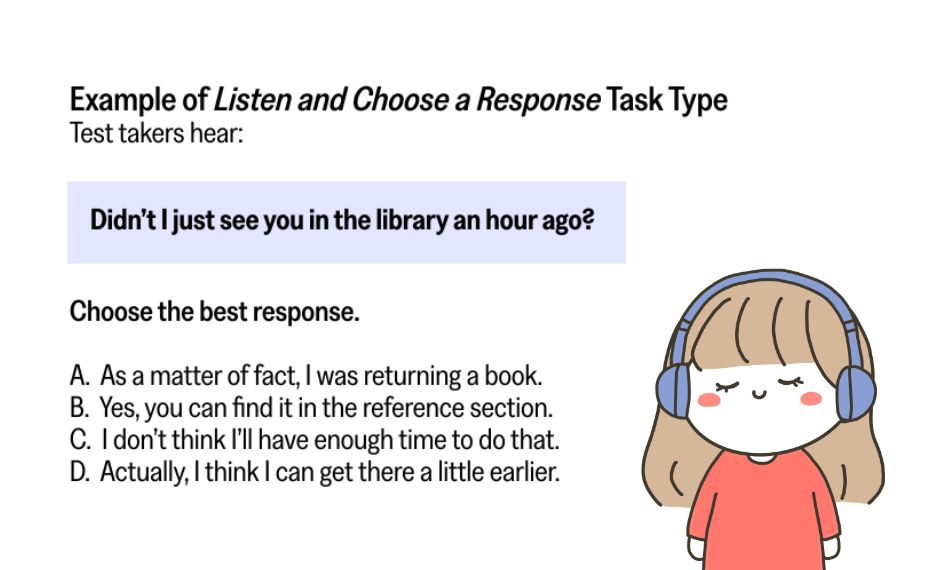 TOEFL Listening 2026 questions train quick responses in context
Task overview:
This task in TOEFL Listening measures how quickly you understand short spoken exchanges and respond appropriately in everyday academic contexts. You will hear a brief line and choose the most suitable reply.
Common topics:
- Campus services such as libraries, registration offices, or IT help desks.
- Class-related situations such as assignments, schedules, or deadlines.
- Student life situations such as clubs, housing, or events.
- Daily interactions such as asking for help, clarification, or directions.
- Academic support topics such as tutoring, advising, or study plans.
- Listen for the speaker’s intention and situation rather than only individual words.
- Pay attention to tone and stress to understand meaning and emotion.
- Eliminate responses that sound grammatically or socially inappropriate.
Listen to a Conversation
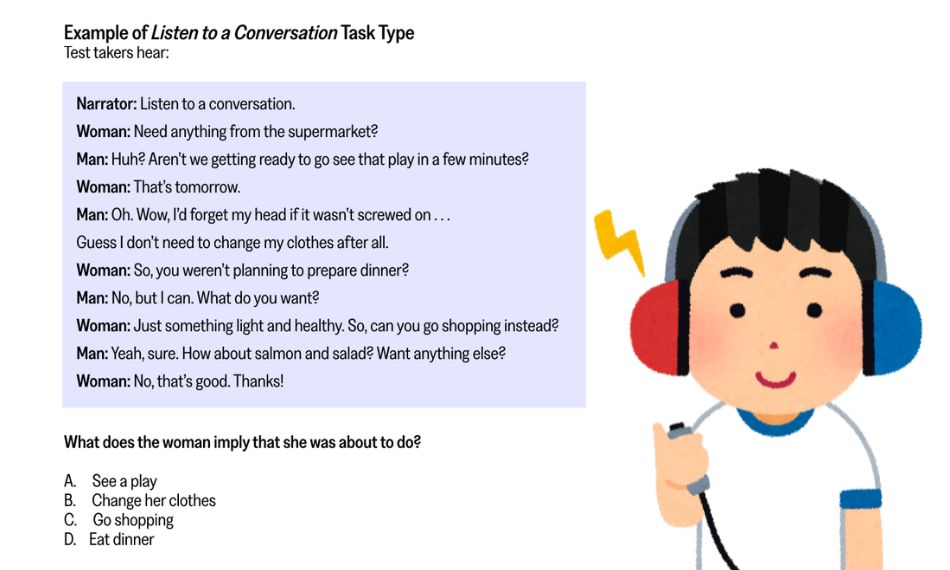 Long conversations assess understanding of purpose, details, and attitudes
Task overview:
As this task focuses on conversations about everyday life, it tests your ability to understand the main idea, key details, speaker roles, attitudes, and implied meaning while following how ideas connect and predicting what may happen next.
Common topics:
- Course registration, schedule changes, or academic requirements.
- Assignment discussions, project planning, or presentation preparation.
- Meetings with professors, advisors, or campus staff.
- Campus services such as library help, housing, or administrative issues.
- Purpose questions: Ask for the main reason the conversation takes place and require understanding of the overall situation.
- Detail questions: Ask for specific information such as actions, suggestions, reasons, or facts mentioned in the talk.
- Attitude questions: Ask about a speaker’s feelings or tone, which must be identified through voice, wording, and context.
- Opinion questions: Ask what a speaker thinks about a topic and whether the attitude is positive, negative, or uncertain.
- Implication questions: Ask about ideas that are suggested rather than directly stated, so the listener must infer meaning.
- Next step questions: Ask what will probably happen after the conversation based on the speakers’ plans or decisions.
- Listen for the main purpose early because it usually appears near the beginning.
- Note key details such as problems, suggestions, and decisions discussed.
- Pay attention to tone and wording to recognize speaker attitude and roles.
- Focus on how ideas connect to understand implied meaning.
- Use the overall context to answer inference and next step questions.
Listen to an Announcement
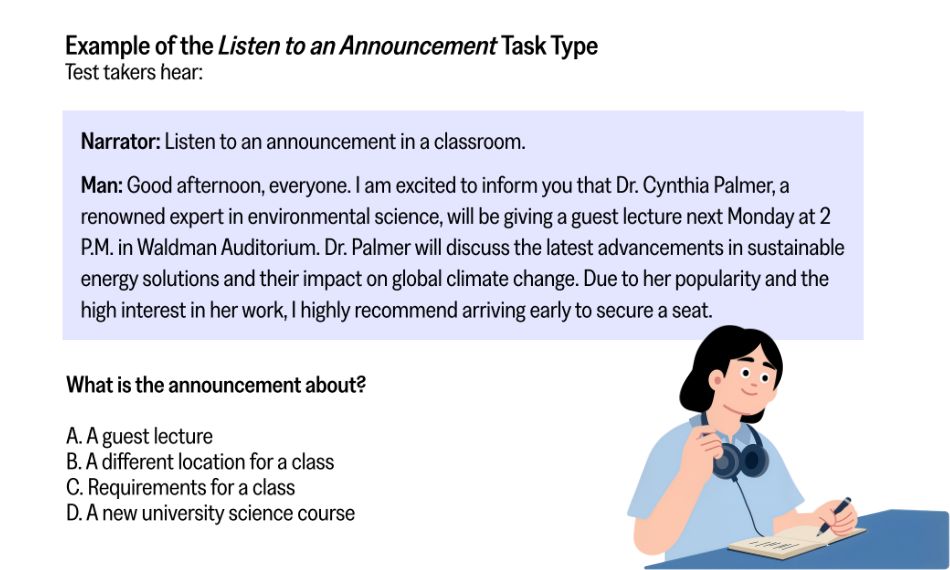 New TOEFL Listening 2026 practice strengthens comprehension of short announcements
Task overview:
This task in TOEFL Listening 2026 includes a short spoken message related to academic or campus information. It assesses your ability to understand the main purpose and essential details clearly.
Common topics:
- Campus event announcements such as workshops, lectures, or club activities.
- Administrative notices about registration, deadlines, or policies.
- Facility updates such as library hours, building closures, or maintenance.
- General reminders or instructions for students and staff.
- Main idea questions: Ask for the overall message or purpose of the announcement.
- Detail questions: Ask for specific information such as time, place, rules, or instructions.
- Purpose questions: Ask why the announcement is being made or what the speaker wants listeners to do.
- Inference questions: Ask you to understand information that is implied rather than directly stated.
- Prediction questions: Ask what listeners will likely do or what will happen next based on the announcement.
- Listen carefully for the main message because it is usually stated at the beginning.
- Focus on key details such as time, location, instructions, or rules.
- Pay attention to signal words that indicate purpose or important information.
- Use context clues to understand implied meaning or missing details.
- Think about the speaker’s goal to predict what listeners should do next.
Listen to an Academic Talk
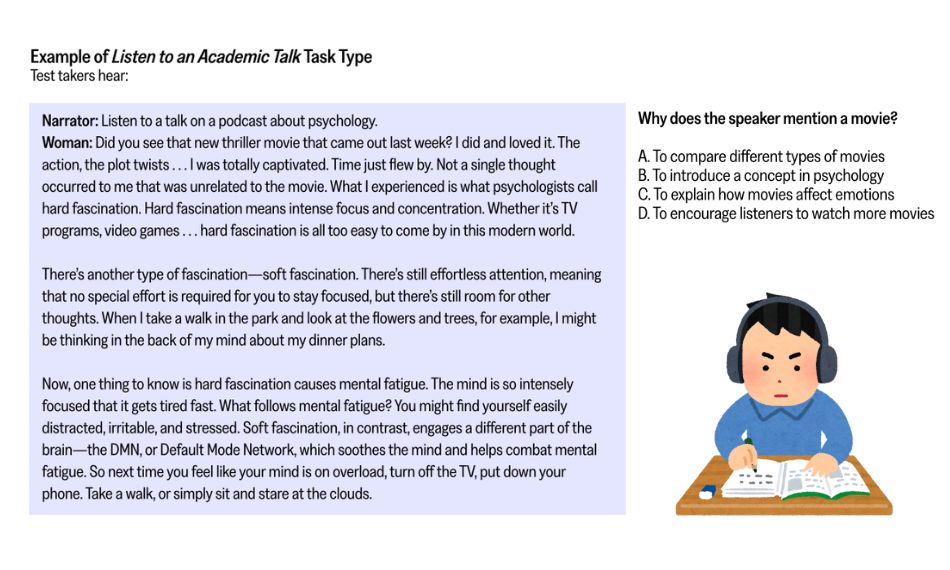 TOEFL Listening 2026 lectures evaluate structured academic comprehension skills.
Task overview:
In this section, you hear a short academic lecture and must show understanding of its central idea, supporting information, structure, vocabulary, and logical connections, while interpreting relationships and drawing conclusions from what is said.
Common topics:
- Introductory lectures explaining concepts from subjects such as biology, history, or psychology.
- Explanations of theories, processes, or research findings.
- Comparisons between ideas, models, or historical events.
- Descriptions of experiments, case studies, or academic examples.
- Main idea questions: Ask for the central topic or overall point of the lecture.
- Supporting detail questions: Ask about examples, explanations, or evidence used by the speaker.
- Organization questions: Ask how the talk is structured or how ideas are connected.
- Inference questions: Ask you to draw conclusions based on information in the talk.
- Vocabulary questions: Ask for the meaning of a word or phrase as used in context.
- Listen for the main idea first so you can understand how supporting points relate to it.
- Notice the lecture structure and signal phrases that show transitions between ideas.
- Write short notes of key terms, examples, and cause-effect relationships.
- Pay attention to definitions or repeated words because they often signal important concepts.
- Use context to guess unfamiliar vocabulary and make logical inferences.