
TOEFL Reading 2026 Latest Changes and Updates
What should you know before taking TOEFL Reading 2026? The format has changed, the section is now adaptive, and the structure is more strategic than before. Before you start practicing, you need a clear understanding of how it works, what types of questions appear, and how scoring is calculated. Estudyme gives you an overview so you know exactly what to expect on test day.
TOEFL Reading 2026 Changes and Updates
What really changed in the Reading part of the TOEFL 2026? Let’s break down the updates you need to know before test day.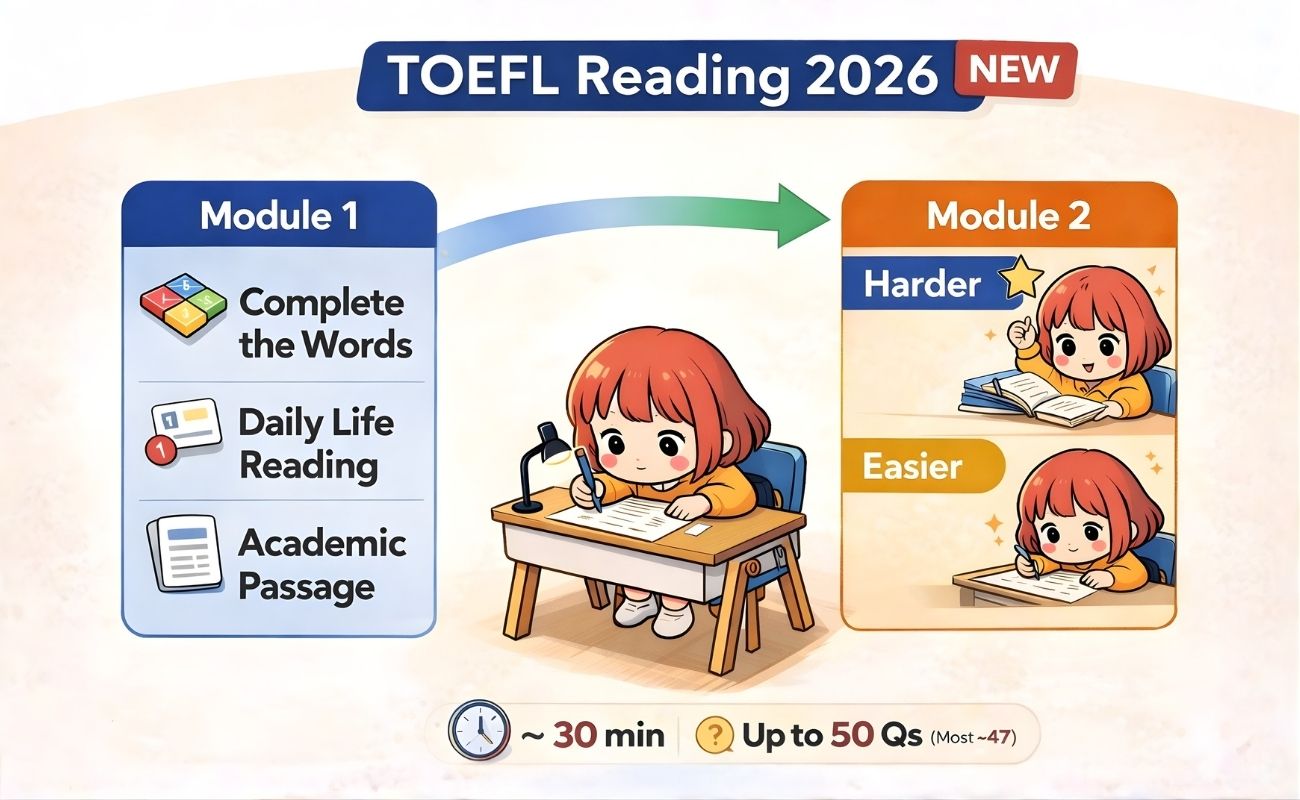 TOEFL Reading 2026 adaptive two-module format overview
- Adaptive two-module structure: You complete Module 1 first, and based on your performance, the system assigns Module 2. Strong results lead to a harder second module, while lower performance results in an easier one.
- Routing module (Module 1): This module has the same level for all test takers. You will get a set of three tasks:
- 1 Complete the Words task
- 1 Read in Daily Life task (short or long)
- 1 Academic Reading passage.
- Performance-based second module (Module 2): The structure remains consistent, but the overall difficulty changes. You complete another vocabulary task, another practical reading task, and two academic passages.
- Routing module (Module 1): This module has the same level for all test takers. You will get a set of three tasks:
- Locked module progression: You may review questions within a module, but once you submit Module 1, you cannot return to it.
- Time allocation and question volume: The total testing time is approximately 30 minutes, with up to 50 questions. Most versions contain around 47 questions.
TOEFL Reading 2026 Question Types
To understand how TOEFL Reading 2026 works in practice, you first need a clear view of how the tasks are distributed across the two modules.| Task Type | Description | Total Questions | Time | Module Distribution |
| Complete the Words | Fill in missing letters in a short paragraph (10 blanks) | ~47 questions | ~30 minutes | Module 1:
|
| Read in Daily Life (short/long) | Answer questions about everyday texts
(short: 2 questions; long: 4 questions) |
|||
| Academic Reading Passage | Answer questions about academic passages (5 questions per passage) |
Complete the Words Task
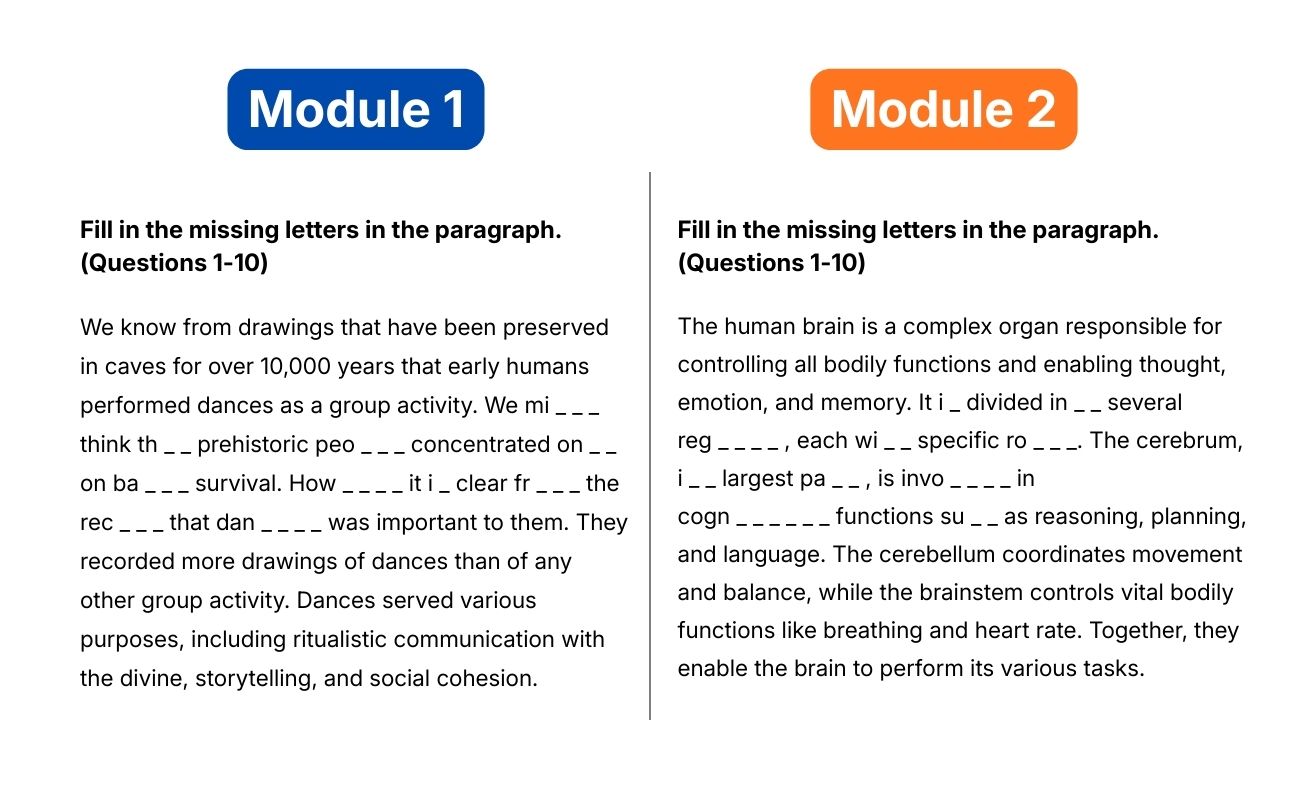
This task assesses how well you control academic vocabulary in context. Rather than testing isolated spelling, it examines whether you can reconstruct academic words based on grammar and meaning within a short passage.How the task is structured:
- A brief academic-style paragraph of around 70 words
- Exactly 10 incomplete words
- Missing letters placed in the second half of each word
- Most blanks concentrated in the second and sometimes the third sentence
- A clear indication of how many letters are missing
What this task actually tests:
- Accurate identification of word form (noun, verb, adjective, adverb)
- Control of academic word families
- Recognition of common stems and affixes
- Grammatical awareness to confirm meaning
The topics remain academic but accessible. Common themes include:
- Psychology
- Biology
- Education
- Urban studies
- Environmental topics
 TOEFL Reading 2026 Complete the Words task example
Daily Life Reading Task
This task checks how efficiently you understand everyday texts in a university setting. The reading is short, practical, and designed to reflect the kind of information you would process quickly in real life.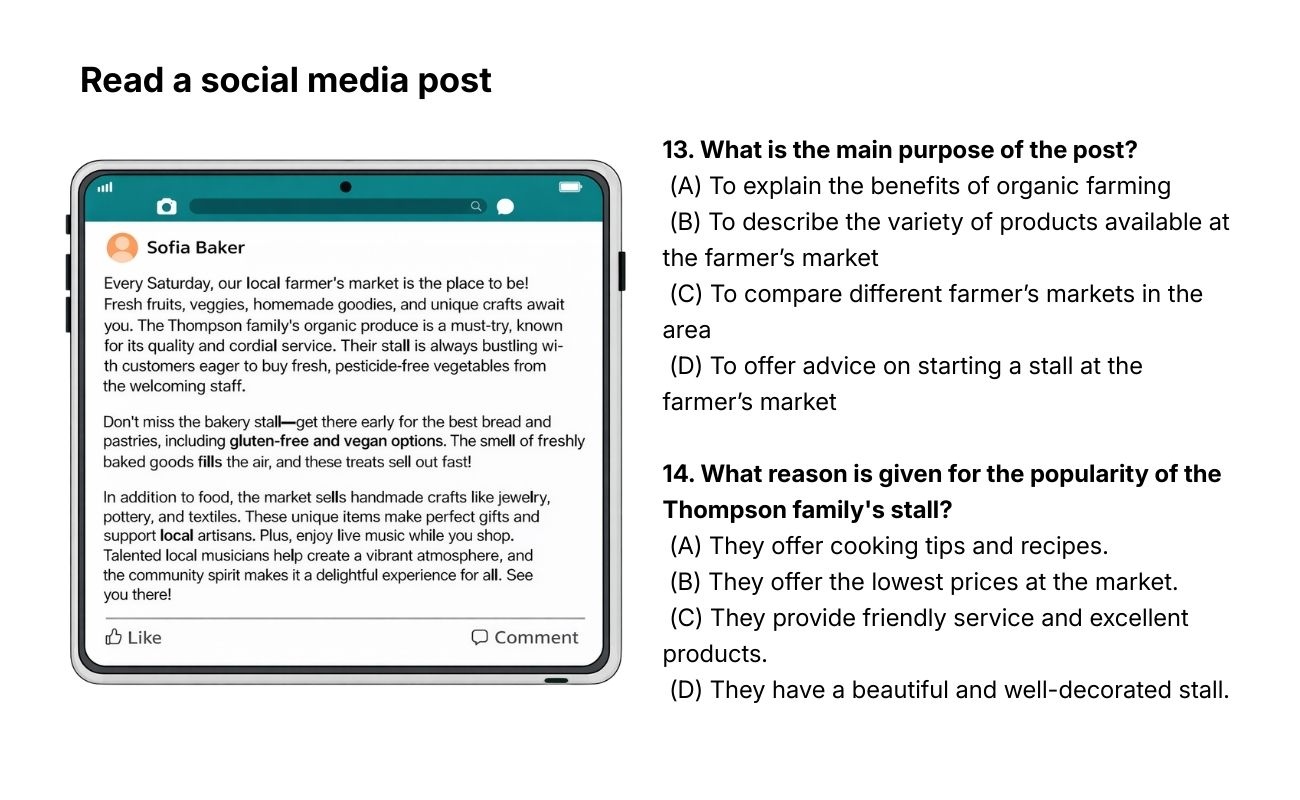 TOEFL Reading 2026 Daily Life Reading task example
Task format and text types
You read a short everyday text, typically about 40-140 words. The source can look like an email, a notice, a memo, a short announcement, an invoice, or a website message…
The task comes in two lengths:
- Short text: 2 questions
- Long text: 4 questions
Most Daily Life texts stay within familiar campus scenarios, such as:
- Assignment clarification or deadline discussion
- Course registration or tuition inquiries
- Library, printing, or facility-related issues
- Club participation or campus events
- Workshop registration or service instructions
Questions are usually straightforward but rely heavily on paraphrasing. Common targets include:
- The main purpose of the message
- The reason it was written
- The next likely action
- A specific detail (time, requirement, condition)
- A mild inference
Academic Passage Task
This task measures your ability to follow academic reasoning within a concise passage. It requires full-text comprehension rather than paragraph-by-paragraph scanning.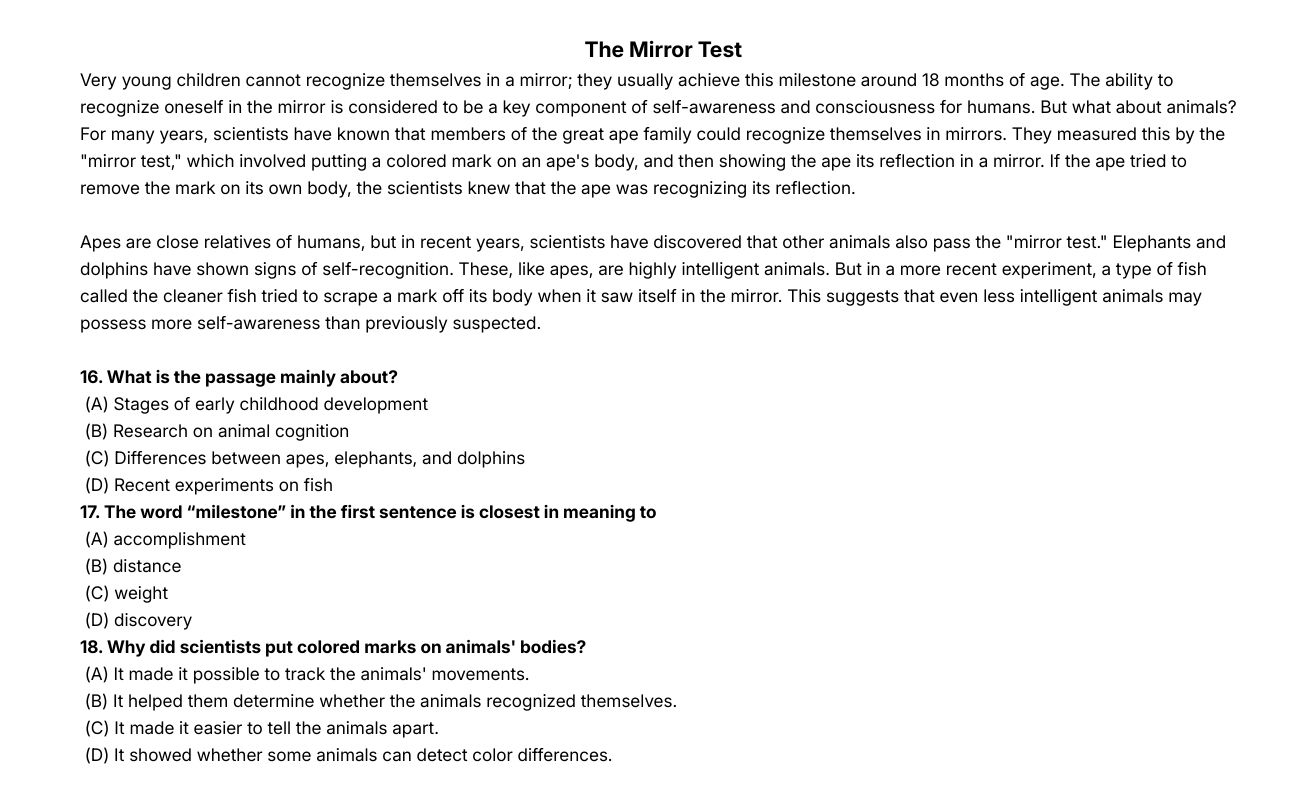 TOEFL Reading 2026 Academic Passage task example
Task format
You read an academic-style passage of around 200 words and answer 5 questions. Unlike the older format, questions do not point you to a specific paragraph, so you must track information across the entire passage.
The content remains academic, but topic choices tend to be more relatable than highly specialized historical or archaeological texts.
Topic profile in 2026
Common themes include:
- Environment and sustainability
- Urban development
- Social behavior
- Psychology
- Technology and society
- Health and lifestyle
- Education systems
- Factual information
- Negative factual information
- Vocabulary in context
- Rhetorical purpose
- Inference
- Paragraph relationship (introduced in 2026)
- Important idea (introduced in 2026)
Many passages follow one of these structures:
- definition followed by example
- advantages versus disadvantages
- problem followed by solution
- cause and effect
- concept followed by application or benefit
TOEFL Reading 2026 Scoring System
How is your TOEFL Reading score actually calculated in the 2026 format? How many correct answers do you need to reach your target band?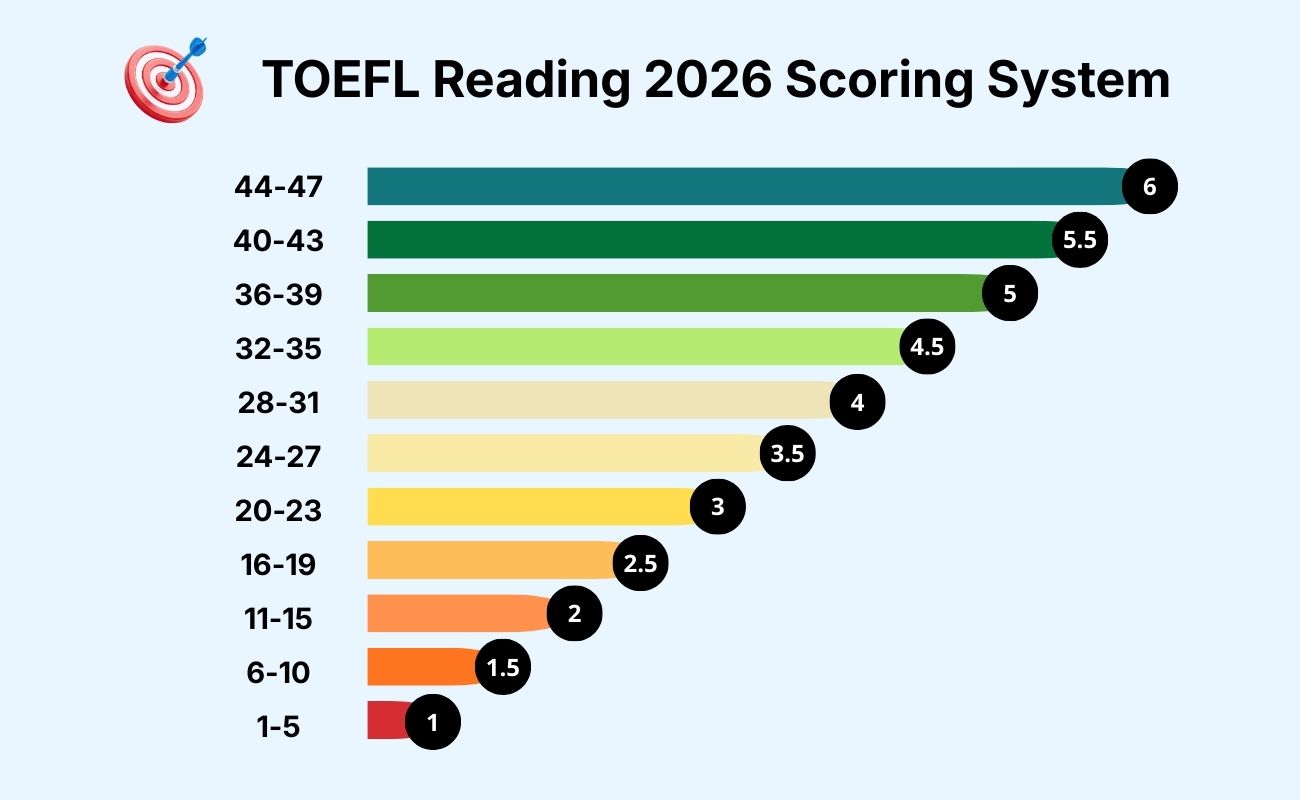 TOEFL Reading 2026 Reading score conversion 1-6 scale
Here is how the raw score converts to the official 1-6 scaled score in the Reading section.
| Section | Raw Score | Scaled Score |
| Reading | 44-47 | 6 |
| Reading | 40-43 | 5.5 |
| Reading | 36-39 | 5 |
| Reading | 32-35 | 4.5 |
| Reading | 28-31 | 4 |
| Reading | 24-27 | 3.5 |
| Reading | 20-23 | 3 |
| Reading | 16-19 | 2.5 |
| Reading | 11-15 | 2 |
| Reading | 6-10 | 1.5 |
| Reading | 1-5 | 1 |
Conclusion
TOEFL Reading 2026 demands more than fast reading. The adaptive structure means your early performance shapes the rest of the section, so accuracy and strategy matter from the very first question.To improve your score, focus on:
- Strong academic vocabulary
- Fast recognition of text purpose
- The ability to follow logical structure in short academic passages.