

7 Common TOEIC Writing Mistakes & How To Avoid Them
Small mistakes can cost you points in the TOEIC Writing test, even when your idea is clear. Maybe the sentence is missing a verb, the word form feels wrong, or the email does not fully answer the request. This guide breaks down 7 common TOEIC Writing mistakes and shows you how to avoid them with practical examples.
What Is TOEIC Writing Test?
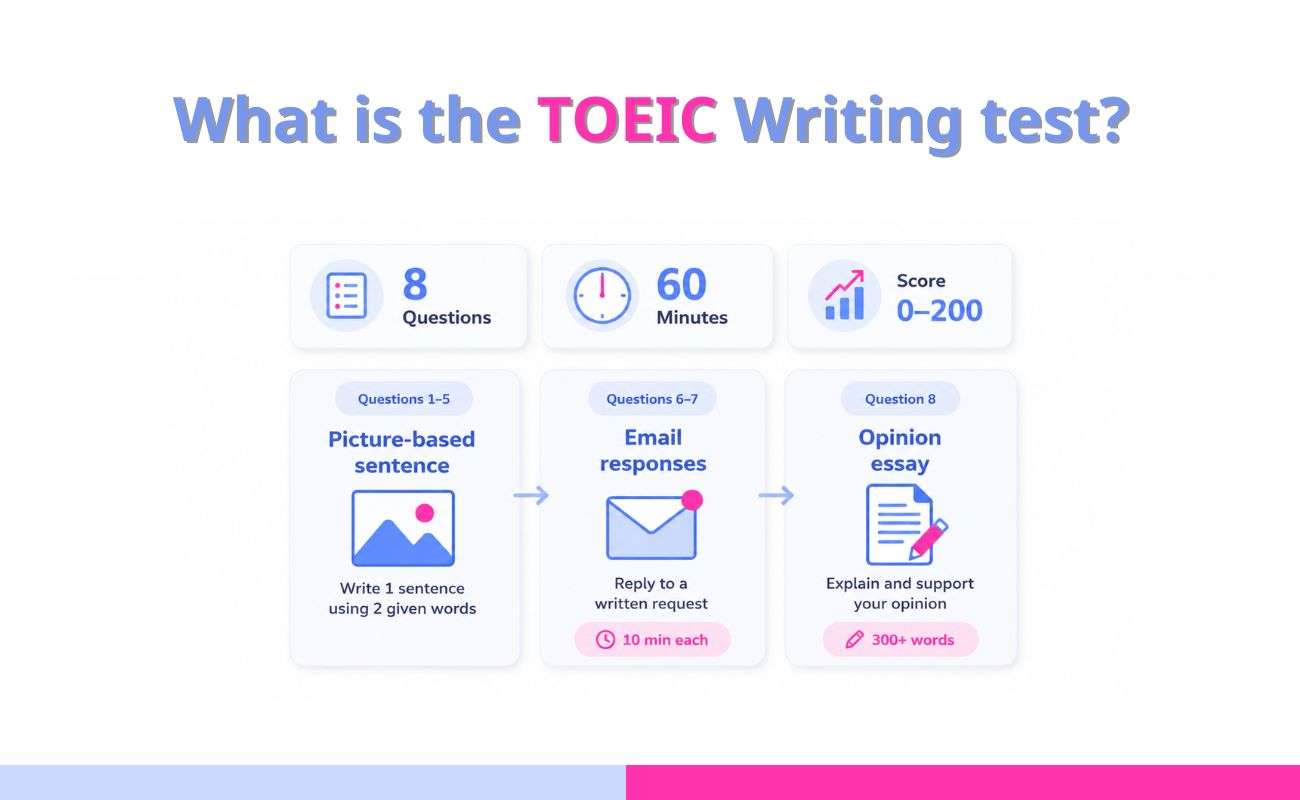 What is the TOEIC Writing test?
The TOEIC Writing test measures how well you can write in English for real workplace communication. You need to write accurate sentences, choose suitable vocabulary, answer the task directly, and organize your ideas clearly.
The test has 8 questions and takes about 60 minutes. Your score is reported on a scale from 0 to 200.
Here is the basic structure:
- Questions 1-5: Write a sentence based on a picture You write one sentence using two given words or phrases.
- Questions 6-7: Respond to a written request You write email responses. Each question gives you 10 minutes.
- Question 8: Write an opinion essay You explain and support your opinion. A strong response is usually at least 300 words.
7 Common TOEIC Writing Mistakes
Let’s look at the TOEIC Writing mistakes that test takers often make and how each one can affect the quality of an answer.1. Grammar Mistakes
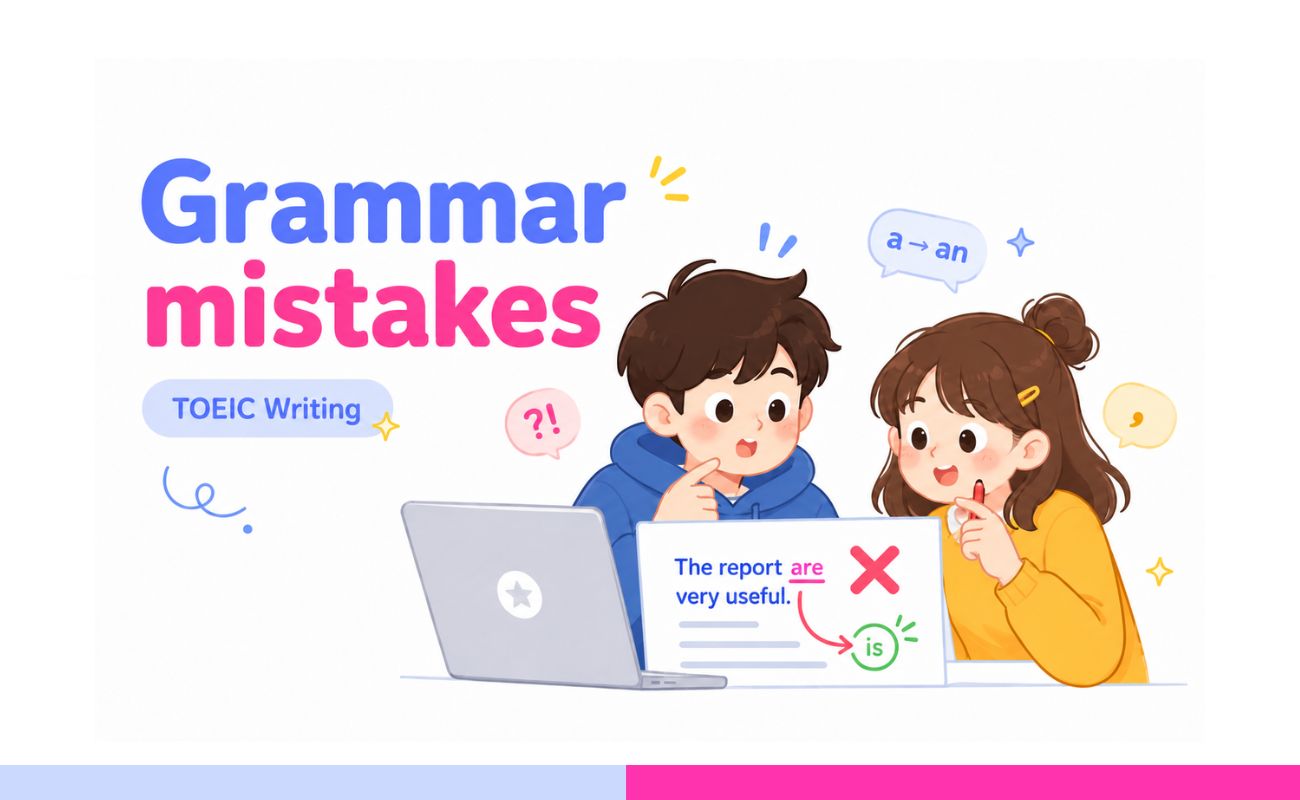 Grammar TOEIC Writing mistakes
In TOEIC Writing Questions 1-5, many candidates describe the picture as if they were taking notes, instead of writing a full sentence. Common grammar mistakes include:
- Subject-verb agreement Incorrect: The people is waiting in line. Correct: The people are waiting in line.
- Missing or wrong verb form Incorrect: The man wearing a helmet. Correct: The man is wearing a helmet.
- Wrong article use Incorrect: A woman is talking to customer. Correct: A woman is talking to a customer.
- Incorrect sentence structure Incorrect: Because the manager is busy. Correct: The manager cannot answer the call because he is busy.
2. Word Form Mistakes
Sometimes, the problem is not that you choose the wrong word. You choose the right word, but use it in the wrong form.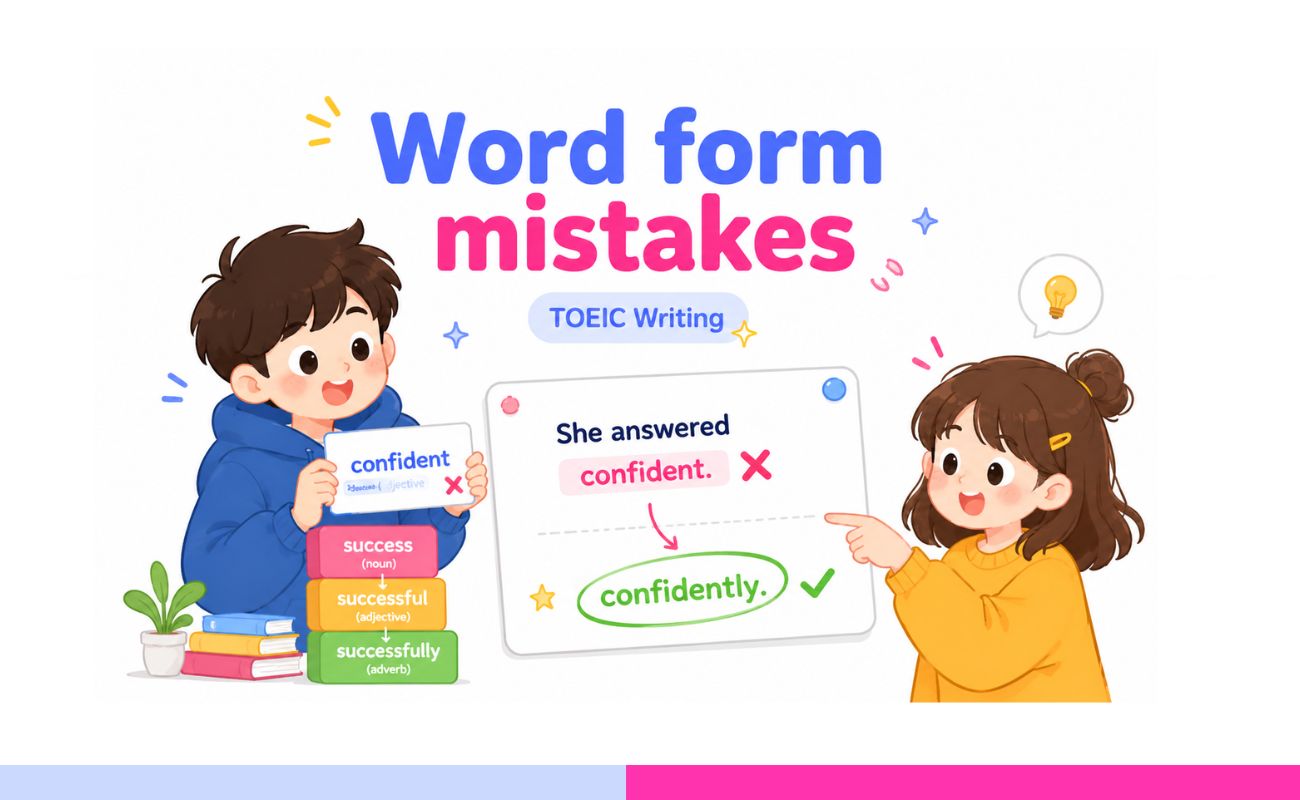 Word form TOEIC Writing mistakes
In TOEIC Writing, this often happens when candidates try to use the required words in Questions 1-5 without changing them correctly.
- After be, you often need an adjective: The presentation was successful, not success.
- After an action verb, you may need an adverb: He answered confidently, not confident.
- After need to / want to / plan to, use a verb: We need to decide soon, not decision soon.
3. Verb Tense Mistakes
Verb tense mistakes can make a good idea confusing. The reader may understand the words, but not the time: Is it happening now, did it already happen, or will it happen later?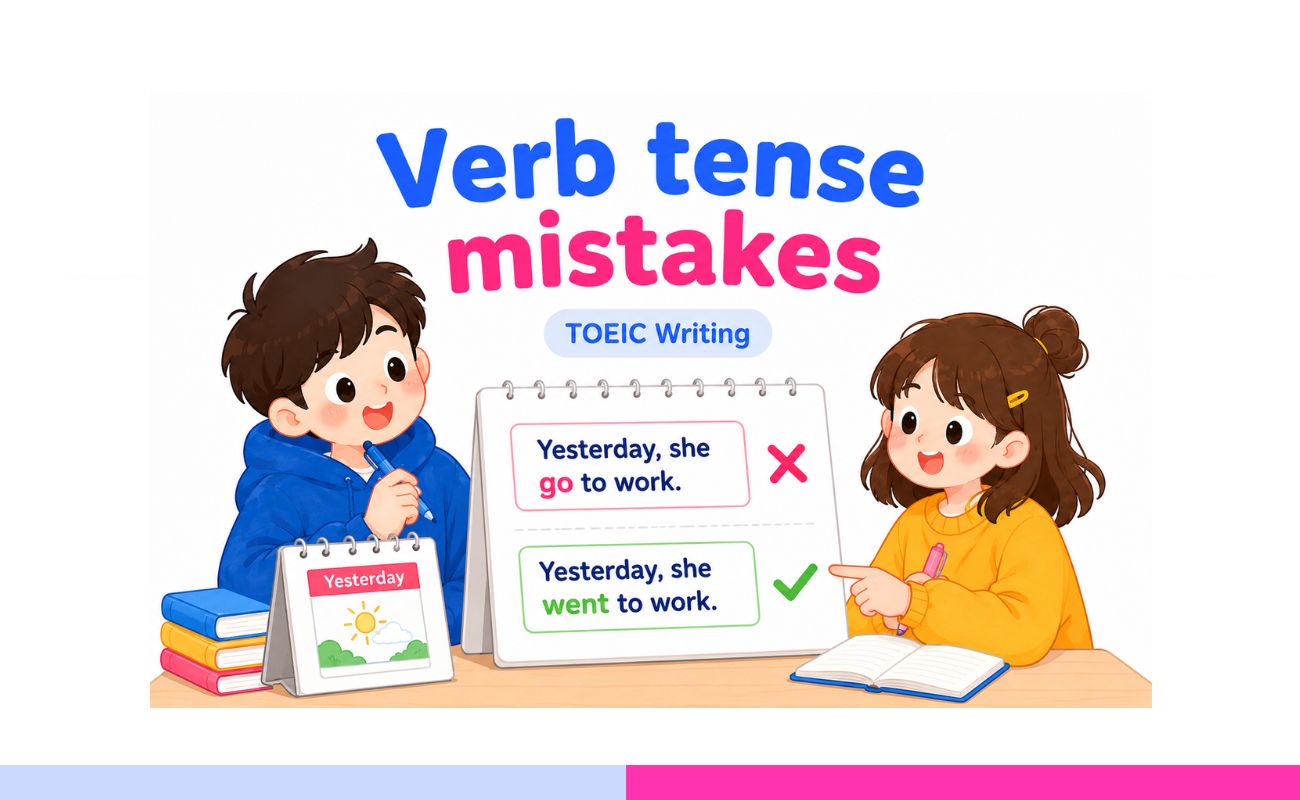 Verb tense TOEIC Writing mistakes
This TOEIC Writing mistake often appears when candidates mix tenses in the same response. For example: In yesterday’s meeting, the manager explained the new policy and asks us to submit the form. A better version is: In yesterday’s meeting, the manager explained the new policy and asked us to submit the form.
In emails, tense mistakes can also make your message less clear. For example, I send you the updated schedule tomorrow sounds awkward because tomorrow refers to the future. A better sentence is I will send you the updated schedule tomorrow.
Before submitting, check time clues such as yesterday, last week, now, currently, tomorrow, and next month. They usually tell you which verb tense to use.
4. Vocabulary Mistakes
In TOEIC Writing, good vocabulary does not mean using big words. It means choosing words that sound natural in a workplace situation.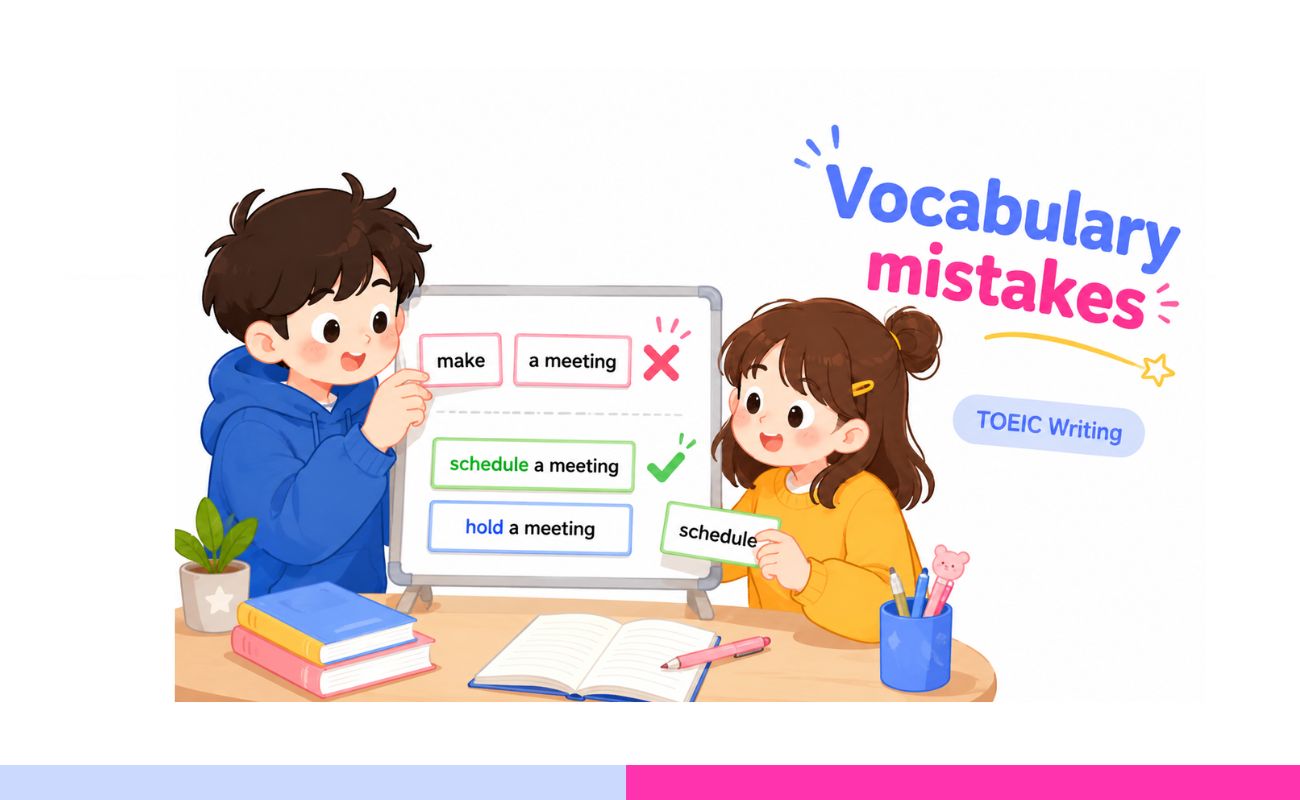 Vocabulary TOEIC Writing mistakes
A common mistake is using word combinations that do not sound natural in workplace English. For example, you do not usually make a meeting; you schedule, hold, or attend a meeting. You do not give an email; you send an email.
5. Task Requirement Mistakes
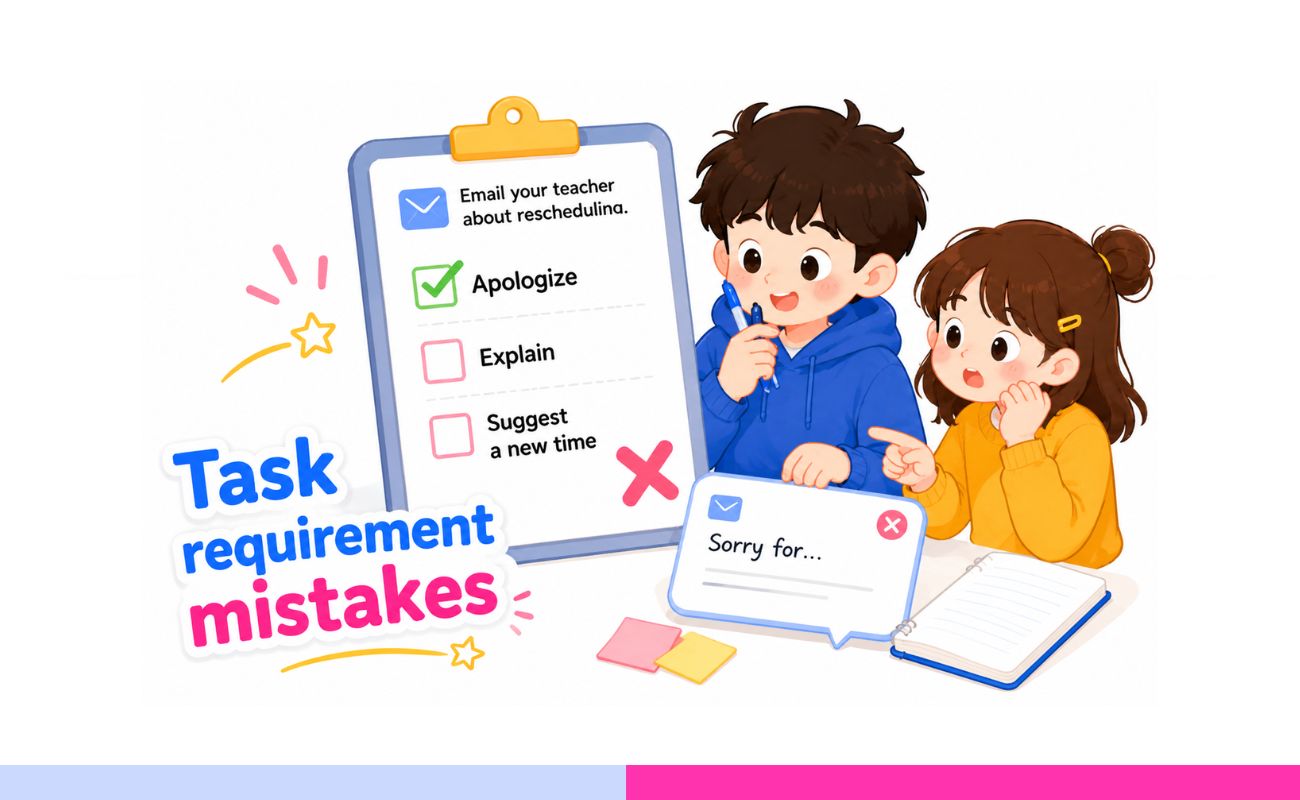 Task requirement TOEIC Writing mistakes
This TOEIC Writing mistake can be frustrating because the English may be fine, but the answer does not fully do what the question asks.
For example, an email prompt may ask you to apologize, explain the reason, and suggest a new time. If you only write a polite apology, the response still feels incomplete.
The same thing can happen in the essay. If the question asks whether you agree or disagree, but your answer only discusses both sides without a clear opinion, the writing may sound balanced but unfocused.
Before writing, underline or mentally note what the task asks you to do:
- What is the situation?
- Who are you writing to?
- How many points must you include?
- Should the tone be formal, polite, or friendly?
See also: How to improve TOEIC Writing skills
6. Organization Mistakes
Organization mistakes are a common TOEIC Writing mistake. They happen when your answer has enough information, but the order makes it hard to read.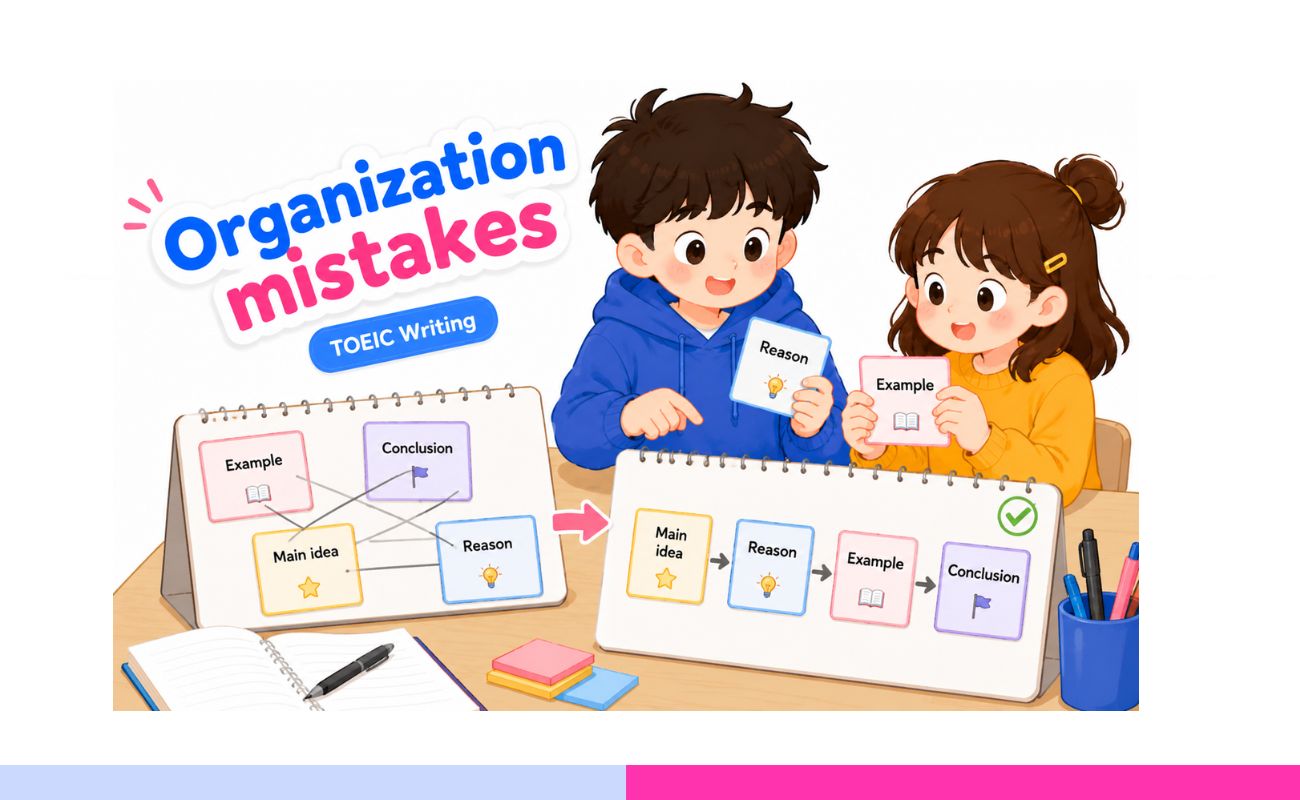 Organization TOEIC Writing mistakes
In an email, this often looks like one long block of text. The candidate says sorry, explains the reason, gives a solution, and ends the message, but everything is packed into the same paragraph. The reader can still understand it, but the response feels messy.
A clearer email should move in a simple order:
- Acknowledge the situation
- Give the needed information
- Suggest the next step
- Close politely
7. Number Mistakes
Number mistakes are easy to miss because they look small. In TOEIC Writing, they can still make your answer inaccurate.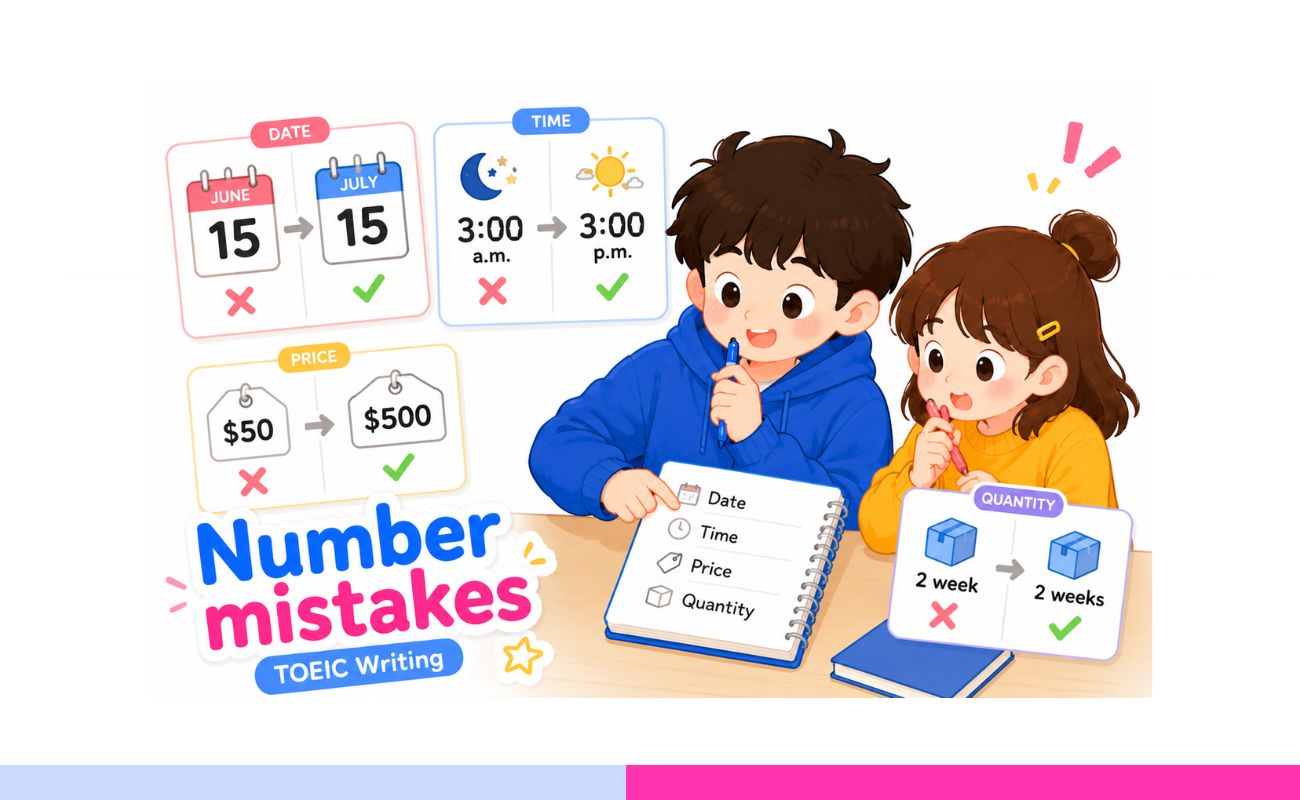 Number TOEIC Writing mistakes
This usually happens with:
- Dates: June 15 vs. July 15
- Times: 3 p.m. vs. 3 a.m.
- Quantities: two week instead of two weeks
- Measurements: a 30-minutes meeting instead of a 30-minute meeting
- Prices: $50 vs. $500
How To Fix TOEIC Writing Mistakes Effectively?
Many TOEIC Writing mistakes can be fixed quickly if you review your answer in the right order.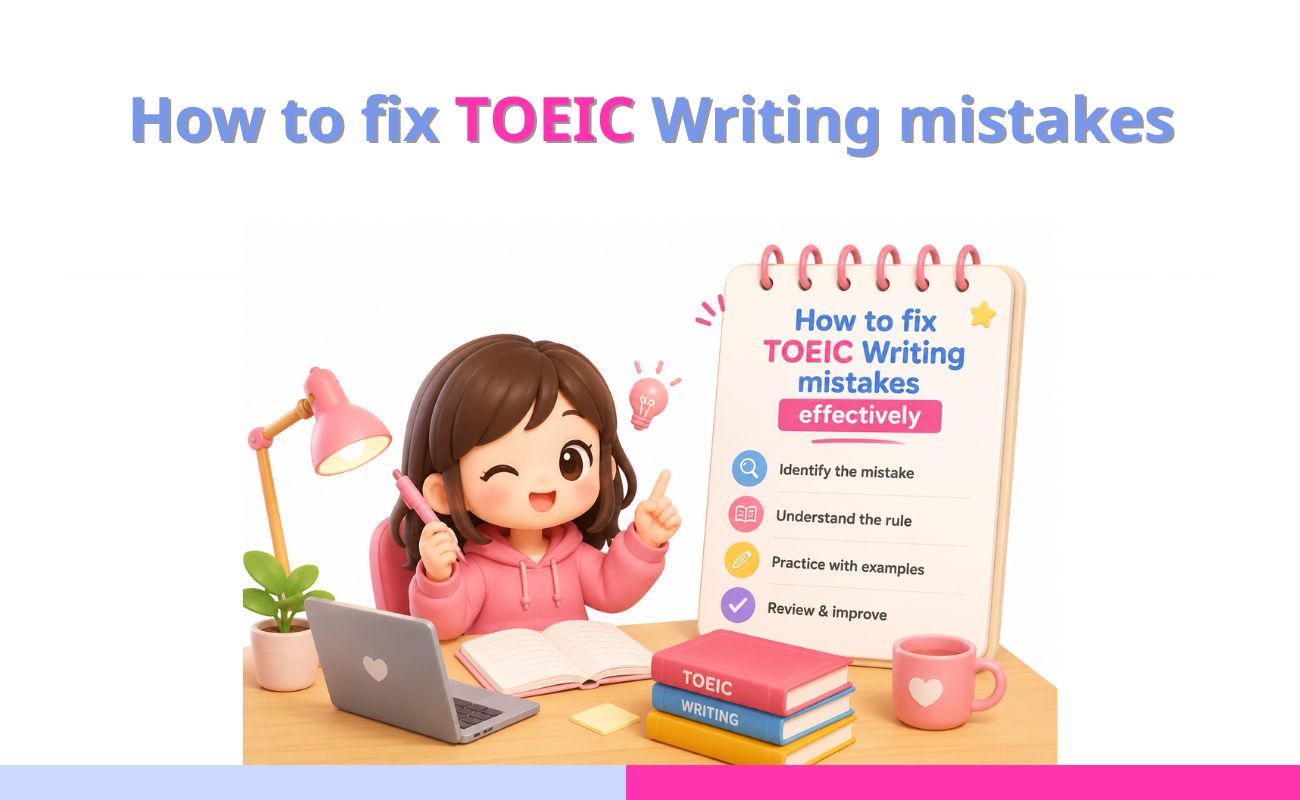 How to fix TOEIC Writing mistakes effectively
- Check the task first: Before you edit grammar, make sure your answer actually follows the prompt. For an email, did you include every required point? For an essay, is your opinion clear from the beginning?
- Read each sentence for one main error: Look at the subject and verb first. Then check verb tense, word form, articles, and plural nouns. This keeps your review simple and faster under time pressure.
- Watch the words you were forced to use: In picture-based questions, many mistakes happen around the required words. Check whether you need to change the form, add a verb, or place the word in a more natural structure.
- Check numbers like important names: Dates, times, prices, quantities, and deadlines should be copied carefully. One wrong number can make an otherwise good answer inaccurate.
- Practice with real TOEIC-style tasks: You improve faster when you write, check, and correct under test-like conditions. Practice TOEIC Writing test to get used to TOEIC Writing tasks and build a cleaner editing habit before test day.